
Insurance rates across the United States are rising, leaving many drivers looking for relief. For most Americans, the “Good Driver Discount” (often called “Safe Driver” or “Accident-Free“) is the most accessible and effective method to lower premiums. While drivers in California operate under strict state mandates, the rest of the country faces a different landscape. National carriers offer variable discounts that typically range from 10% to 40%. These figures depend heavily on state laws and the specific rating system a company uses.
Understanding the mechanics of these incentives is essential for lowering your monthly bill. We will examine the two primary types of safe driver incentives—historical records versus real-time telematics—along with the eligibility requirements that cross state lines. Because these discounts vary significantly by carrier, understanding these details empowers you to shop competitively and secure the best rate.
The Two Pillars of Safe Driving Savings
Outside of specific state mandates, savings for safe driving generally fall into two categories. You have traditional retrospective discounts, which look at your history, and modern usage-based insurance (UBI). In the current economic environment, these are often the largest single price breaks available on a policy.
While the mechanism differs by carrier, the underlying goal remains consistent. Statistically, lower risk equals lower rates.
Financial Benefits and Savings Potential
The savings potential here is substantial. Traditional “clean record” discounts typically offer 10–25% off your premium. However, newer UBI programs using telematics can push that savings bracket up to 30–40% if you demonstrate excellent real-time driving behavior.
Drivers often assume these discounts are automatic. In many states, you must explicitly enroll in telematics programs or request a policy review to trigger these savings.
You should also consider the value of “stacking” savings. This strategy involves combining a Good Driver discount with features like “Accident Forgiveness” or “Vanishing Deductibles.” Think of this as compound interest for insurance. A Good Driver discount lowers your base rate today. Simultaneously, a Vanishing Deductible lowers your potential out-of-pocket cost for a future claim. Over five years of accident-free driving, you lower your monthly bill and reduce your financial liability in the event of a mishap.
The Shift to Usage-Based Insurance
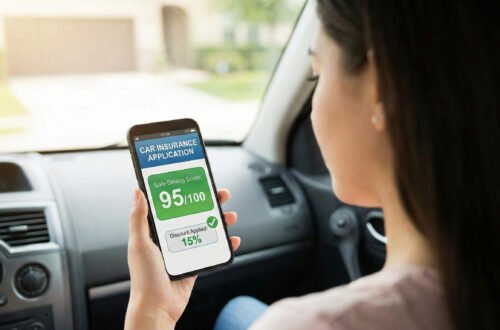
Insurers are increasingly replacing or supplementing historical checks with mobile apps or plug-in devices. These tools monitor specific behaviors such as hard braking, acceleration speed, and phone usage while driving.
Most programs offer a “participation discount” immediately upon signing up. This is a smaller, guaranteed reduction just for trying the program. The significant “earned discount” is applied at renewal based on the actual driving data collected during the policy term.
For younger drivers or those with short credit histories, telematics offers a shortcut. A traditional history check might not show enough data to prove you are a safe driver. Usage-based insurance allows you to prove your low-risk status immediately rather than waiting years to build a record.
Universal Eligibility Requirements and Conditions
While every state has a different “points” system for traffic violations, the insurance definition of risk is generally consistent across the 50 states. Carriers utilize reports from the CLUE (Comprehensive Loss Underwriting Exchange) and MVR (Motor Vehicle Report) to verify eligibility at every renewal.
Consistency is the primary requirement. A single bad day on the road can reset the clock on these discounts.
The “Lookback Period” and Clean Record Criteria
The industry standard “lookback period” is the window of time an insurer reviews to assess your risk. This is typically 3 to 5 years. While California has a strict 3-year mandate, other states and carriers often look back 5 years when determining eligibility for major savings.
To qualify, you generally need a record free of “chargeable accidents” (at-fault claims) and “moving violations.” It is helpful to distinguish between violation types. Non-moving violations, such as parking tickets or fix-it tickets for a broken tail light, usually do not impact your insurance rates or discounts. Moving violations, such as speeding or running a red light, indicate risky behavior and will likely disqualify you.
Continuous insurance coverage is also a strict requirement. If you let your policy lapse, even for a few days, you may lose your status in the “preferred” rating tier. This applies even if your driving record is spotless. Insurers view gaps in coverage as a statistical indicator of higher risk.
Disqualifiers and State-Specific Nuances
Certain major disqualifiers apply nationally. Convictions for DUIs, reckless driving, or driving without a license typically freeze eligibility for Good Driver discounts for 7 to 10 years.
A common challenge for families is the “mixed household.” If one driver on your policy is high-risk, it can eliminate the Good Driver discount for the entire household in certain states. In these scenarios, you may need to sign a named driver exclusion for the high-risk individual to preserve the discount for the other drivers on the policy.
Drivers in “No-Fault” states like Michigan or Florida face specific nuances. The criteria for what constitutes a “chargeable claim” may differ regarding personal injury protection (PIP) claims. You should clarify with your agent how minor PIP claims impact your discount eligibility in these jurisdictions.
Navigating a Competitive Market
Good Driver discounts are the most powerful tool available for lowering your insurance rates. Securing them requires protecting your driving record and potentially embracing telematics technology.
Since this discount is not federally mandated, one carrier’s “Good Driver” rate might be vastly different from another’s. Shopping around is the only way to ensure you are receiving full value for your clean record.
To take action today, request a copy of your CLUE report to ensure your claims history is accurate. Then, ask your insurance agent specifically about “telematics” options to see if you can lower your rate through real-time driving behavior.
For residents of California, check out our article on the Good Driver Discount in California.
Further Readings & Resources
- Insurance Information Institute (III) – Saving Money on Auto Insurance: https://www.iii.org/article/nine-ways-to-lower-your-auto-insurance-costs
- National Association of Insurance Commissioners (NAIC) – Consumer Guide: https://content.naic.org/consumer/auto-insurance.htm
- Consumer Financial Protection Bureau – Understanding Consumer Reporting: https://www.consumerfinance.gov/consumer-tools/credit-reports-and-scores/



One comment on “Unlocking Savings with Good Driver Discounts Nationwide”